Monday, March 21, 2011

Spring has sprung!

Yes, this is the first day of spring in Washington... What you can't see are the 30+ mph winds that kept us hunched as we headed for the summit of McCausland, a peak near Stevens Pass. Thanks to Lisa for the pic...

In other news, our permits for the house came through, and we're planning on breaking ground April 4th! Already spring seems to be racing by, with too many things to do in too short a time. The bees are to come shortly after, any volunteers to come take pictures as I dump them in the hives?

Hope you're all enjoying spring!

Friday, February 11, 2011

The buzzing of bees (in my head)...

Any guesses what this is?


I really had no idea how much of a world beekeeping is, populated with many new enthusiasts, a few old beekeepers, many conflicting theories, burgeoning new research... Knowing that CCD has demolished most feral bees and many hobby and commercial hives and in keeping with the permaculture philosophy of a sustainable homestead, I want to keep bees for pollination and some honey. After sitting through a local beekeeper's meeting, talking with a couple of family friends with varying views of conventional beekeeping with Langstroth hives, and reading oh-so-many blogs and forums about bees, there is about an entire hive buzzing in my head...
Wasp and Honeybees
A few interesting things about bees:
  • A busy summer hive can have as many as 60,000 bees
  • A hive will only have a few hundred male 'drone' bees, and they get kicked out of the hive in autumn, no dead weight to drag the hive down in the winter
  • Hives used to survive basically on their own, my friend's hive producing 160lbs of surplus honey each summer
  • Bee hives now have to be nursed along, many producing only 20-40lbs of surplus honey and many dying in the winter.
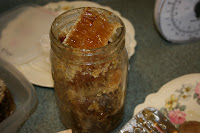
Crushing Comb in JarAnyway, we'll see what I've decided after my beginning beekeeping class tomorrow, but I'm thinking now that I will go with an alternative hive setup, the top bar hive, originally from Greece and used in many developing countries because of their low cost and self-containment. The benefits of this hive over conventional Langstroth hives is they allow for a more organic experience for the bees (no drugs or medicinal treatments), they don't require storage of the many boxes and extra tools required for the life cycle of bees in Langstroth hives, and they allow bees to more naturally create their own combs. Hopefully they will lead a life less stressed by chemicals and pesticides, pests, and disruption than those in conventional hives. They do require more regular intervention from the beekeeper in keeping the free-hanging combs straight and don't usually produce as much honey. If you're interested in this, check out these links: http://www.biobees.com/ and www.bushfarms.com/bees.htm. So, we'll see how it all works out, stay tuned for pics of me hiving bees for the first time in April!

Friday, February 4, 2011

The sun still exists!

Some pics from a snowshoe with a friend Wednesday, just east of Snoqualmie Pass... With a late start, we sipped tea for an hour on Domerie and soaked in the peaceful late-afternoon views, while directly south on the Oregon/Washington border, wind gusts were up to 70mph! You've gotta love our mountains for the inversions and crazy weather they bring, as well as adventure ;)

Wednesday, February 2, 2011

Dawn with the goats...


Here are a couple pictures of the goats I work with a couple days a week, milking and sanitizing the raw milk certified St. John's Creamery. The milk is delicious, tasting basically like cow's milk because we get it on ice within an hour of milking. It's always a little hard to get up at 5am to drive to the farm, but then I drive against traffic and I'm always grateful that I'm not in the long string of cars driving from the suburbs to work in the city in the hours before dawn. Instead, I get to see happy goat faces eagerly following me as I bring around the food and feel the satisfaction of emptying udders.

Monday, January 31, 2011

Thought-provoking media...

180 Degrees South [DVD]

Just a quick post here about a movie (and book) I loved, 180* South, a beautiful kind of adventure film about climbing, climbing history, and environmental perspectives that made me laugh and inspired me, as well as reminding me that the house-building process is just the first in a series of choices in our life that are going to tie us down. I'm about seven parts excited about the future and one part sad about the paths that are probably either gone or on hold for some years...
The Dirty Life: On Farming, Food, and Love [Book]


And then I've just started reading Dirty Life: On Farming, Food and Love and kept laughing out loud and reading passages to Jon while he was trying to do serious things like write grant reports for Search and Rescue...


House Plans

For those interested, this link should take you to a package of our drawings. The interesting pages are:
  • 1 - the site layout including existing shop, house, garage, goat barn, garden, orchards, etc.)
  • 3 - the downstairs, kind of a daylight basement with the bedrooms, a root cellar and guest room
  • 4 - the upstairs, the main living area, basically one big room harnessing sun from the south and a big deck, as well as windows and a little deck looking north and east, to take in the mountain view
  • 8 - some 3D shots of the exterior, to give you some ideas
Some other cool features that we're excited about, we have a long piece of plexiglass in front of the windows by the south deck upstairs, to allow sunlight to filter downstairs into the hallway, as well as the root cellar (partially built into the slope), a 'living roof' on the garage, and probably wool insulation! I've been (mostly) enjoying spending hours in front of the computer looking up products like wool insulation, plants suitable for a living roof in our climate, how to build a root cellar, and designing the goat barn. For some cool sites, check out the wool company Oregon Sheperd, a cool looking living roof on the Ballard library in Seattle, and a great site to follow the crazy antics of the journalist-turned-sustainable-living-writer Doug Fine.

Saturday, January 29, 2011

The first chapter...

Our first excited project, which Pie graciously helped me bring to physicality, was a beautiful composting toilet, complete with a transparent roof through which to see the stars. After a couple weeks of design, shopping and construction, we got it near enough done to have a celebratory BBQ.
Then, sadly, word got around and the health department politely requested it's demise, so all that remains is the cement pad, paying homage to the cheery building.